

It is an interesting time to be alive, especially when living in the epicenter of America’s coronavirus COVID-19 outbreak. In the past week, school districts and restaurants have closed, events have been canceled, and Seattle has transformed from a bustling tech city into a ghost town. Some may call this reaction overboard, but from a public health perspective, it is absolutely necessary. Washington State was the first state in the United States to have a confirmed case of the novel coronavirus COVID-19, and it is up to us to set a good example for the rest of the country.
We live in a globally interconnected world, where the spread of disease happens rapidly. For those of us who have played the Pandemic board game, we know that that we must all work cooperatively to stop its spread. As of today, there are 2,499 confirmed cases and 55 deaths due to the novel coronavirus COVID-19 in the United States (as according to Worldometer), and it hasn’t even reached its peak yet.
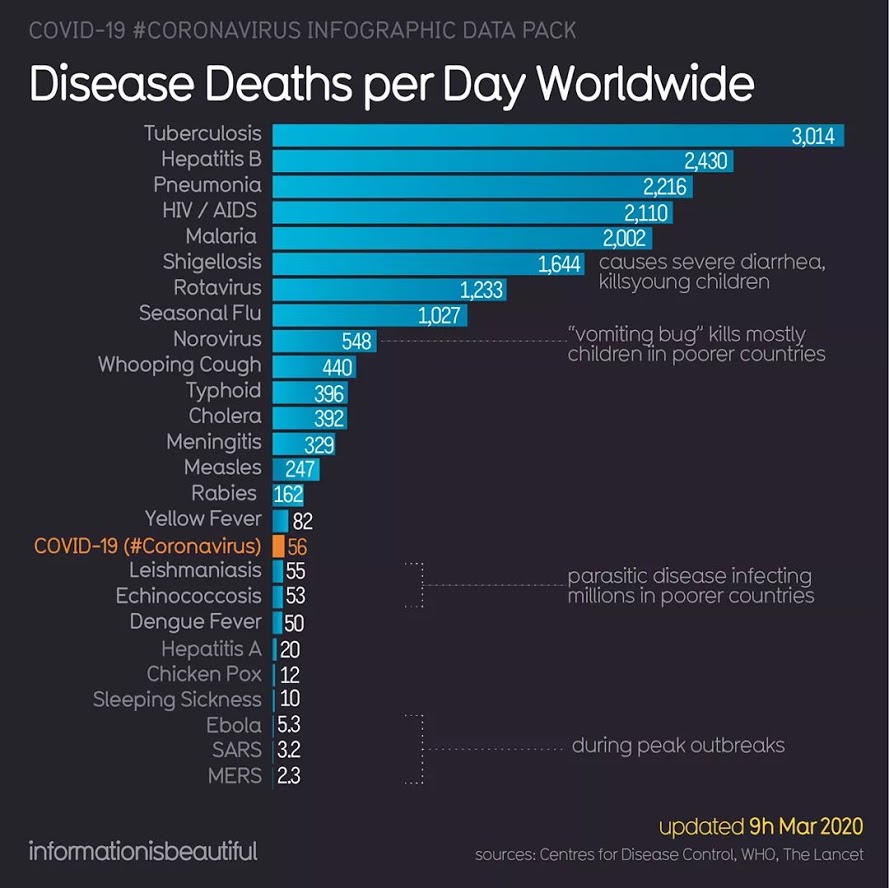
Statistically, coronavirus COVID-19 is a disease unlike one we have seen before in our lifetime, and comparisons of COVID-19 to the flu are not accurate. Although both are contagious viruses that cause respiratory illness, COVID-19 is far more infectious and far more deadly than the flu. While the flu has a mortality rate of 0.1%, COVID-19 has one that is at least 10 times that, with older people and those with serious health conditions at much higher risk. Without vaccines, treatments, or immunity to the novel coronavirus, all we can do as a society is to implement preventative measures and be abundantly cautious.
It is also important as a society not to panic. Mass hysteria is not the solution, and we must take measures to avoid overwhelming a healthcare system that does not have the capacity or supplies to deal with an epidemic of mass scale. The reason that medical professionals are advising people to stay at home unless they experience high fever and difficulty breathing, even if they suspect that they might be infected, is to be able to provide access to health care to those with more acute cases. The reality is that many people in Seattle, including myself, may have already been directly exposed to the disease and exhibit mild to no symptoms, but we are not the ones at risk. Those at risk are the minority of the population with severe or critical cases, and the best thing we can do at this point is to enforce social distancing and self-quarantine to avoid transmitting the disease to others.
The eight charts below represent data we have collected so far on coronavirus COVID-19.
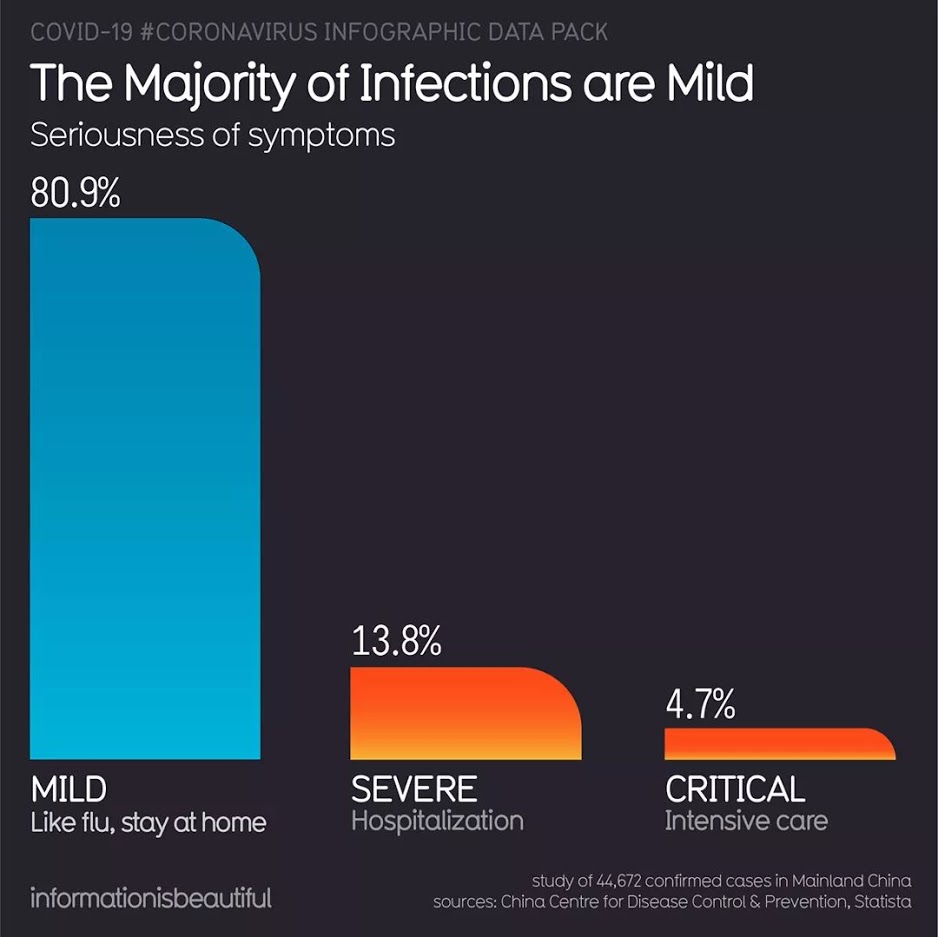

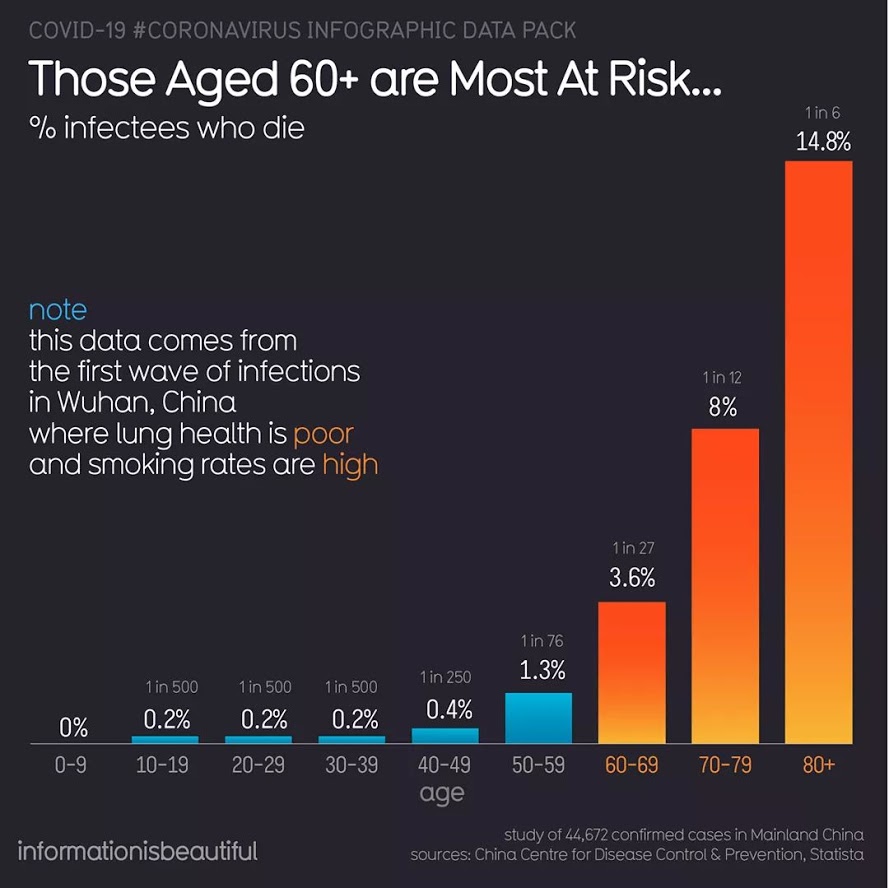

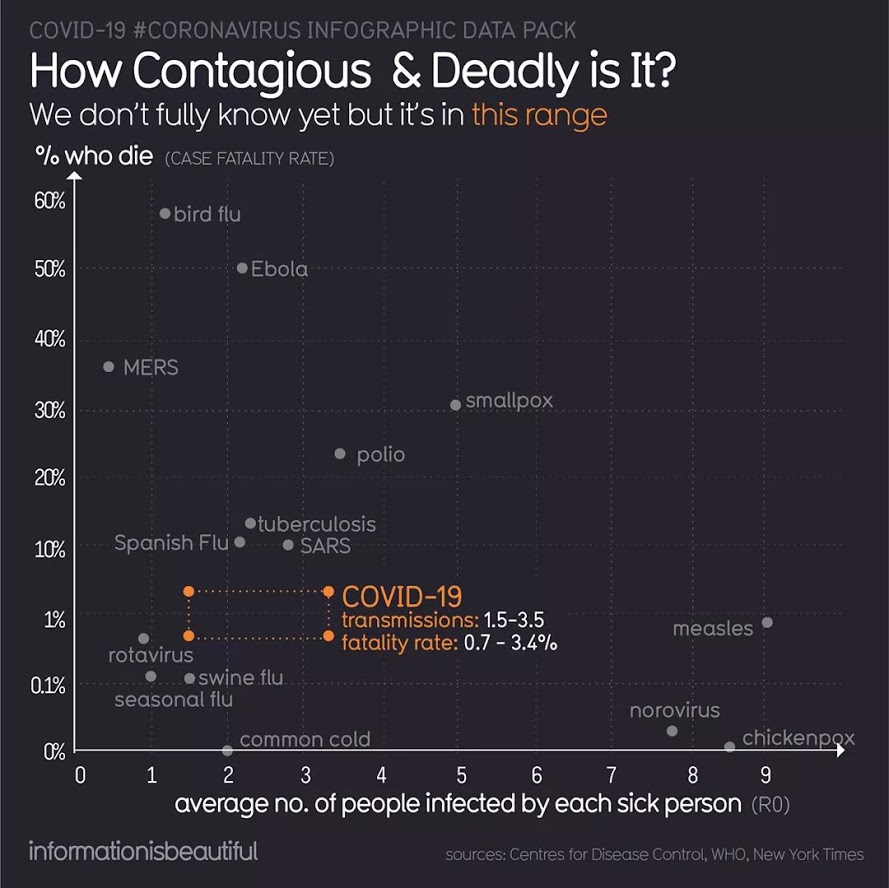
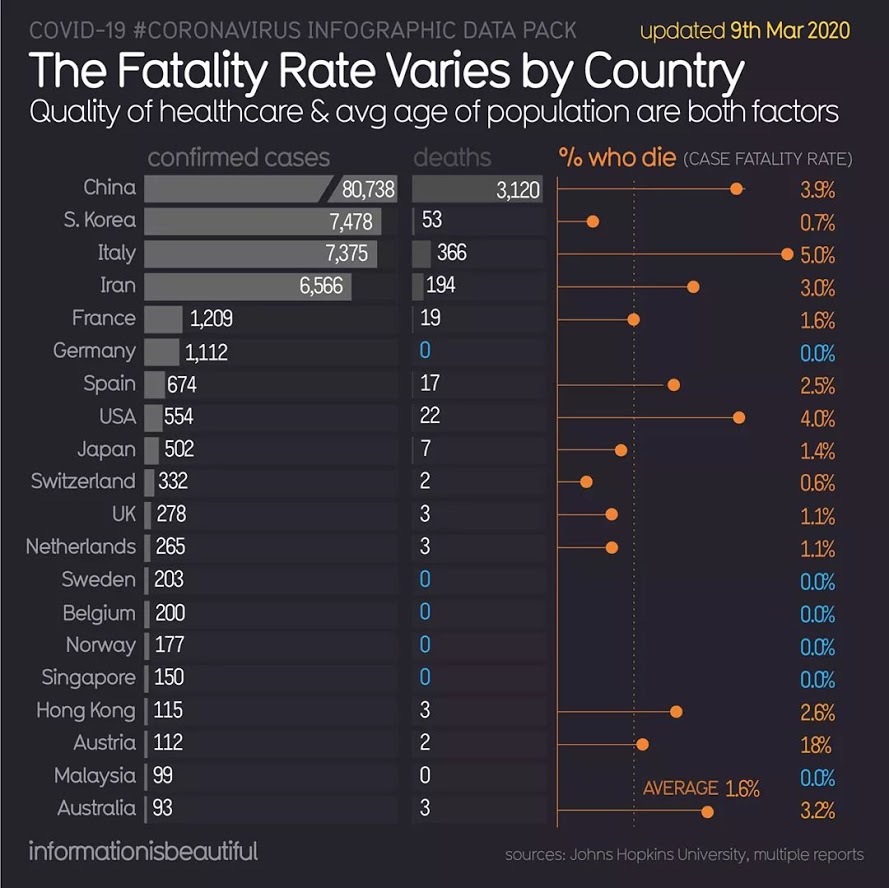

In order to control the COVID-19 outbreak, epidemiologists talk about “flattening the curve”. In the chart below, the curve in red shows the sharp spike in cases that could occur if we don’t take preventative measures. The second curve in blue is the goal. If we do take preventative measures, the number of cases is lower and is spread out over a longer period. Flattening the curve gives the U.S. healthcare system more time to build capacity, develop treatments, and find a vaccine.

In order to “flatten the curve” in Washington State, several containment measures have been implemented by officials. For perspective, a chronology of events for Washington State (WA) is shown below, as reported by KIRO 7.
- January 21 – The first U.S. coronavirus case was confirmed in Washington State.
- February 29 – The first U.S. coronavirus-related death was confirmed in Washington State. The death was linked to Life Care Center in Kirkland, where dozens of residents reported symptoms.
- March 1 – A man in his 70s with ties to Life Care Center in Kirkland was the second person to die from coronavirus in King County, WA.
- March 2 – The WA state death toll for coronavirus jumped up to 6, with 14 new coronavirus cases in Seattle and King County, including 5 new deaths.
- March 3 – The WA state death toll increased to 9, with Life Care Center in Kirkland as the epicenter of the outbreak. Seattle Mayor Jenny Durkan declared a state of emergency.
- March 4 – The WA state death toll increased to 10.
- March 5 – The WA state death toll increased to 11. The Amazon, Microsoft, Nordstrom, Starbucks, and Boeing corporate offices advised employees to work from home.
- March 6 – Emerald City Comic Comic and other large events both locally and nationally were canceled. Several local universities – including the University of Washington, Seattle University, Seattle Pacific University, and Bellevue College – announced that classes would no longer meet in person.
- March 7 – The WA state death toll increased to 16, with at least 102 confirmed cases statewide. The St. Patrick’s Day parade and Irish Week events in Seattle were canceled.
- March 9 – The WA state death toll increased to 22, with the number of deaths linked to Life Care Center in Kirkland at 19.
- March 10 – The number of confirmed cases in WA state reached 269, with a predicted 1,100 active infections, according to Bedford, a computational biologist at Fred Hutchinson Cancer Research Center, and his collaborators.
- March 11 – The WA state death toll increased to 27. Governor Jay Inslee banned gatherings of more than 250 people in King, Pierce, and Snohomish counties in Washington State.
- March 12 – The WA state death toll increased to 31 from 457 confirmed cases. Governor Jay Inslee said all schools in King, Pierce, and Snohomish counties would close through April 24. Some Seattle hospitals and the Washington Department of Corrections banned visitors. Seattle Mayor Jenny Durkan announced that all library locations and community centers would be closed starting March 14 until at least April 13.
- March 13 – The WA state death toll went up to 37 from 570 confirmed cases. Governor Jay Inslee stated that all Washington schools would be closed until April 24, not only those within certain counties. Evergreen Health Hospital announced that it is canceling elective surgeries per CDC guidelines.
As of yesterday, we are also in a state of national emergency, which frees up additional federal funding to combat the outbreak. Hopefully, as a result, we will be able to identify cases earlier, and people who test positive will be able to take extra precautions to isolate themselves and limit transmission.
In the meantime, I’m doing my part by staying close to home and limiting social interaction. I feel lucky to have a job that allows me to work from home, and I have canceled all international travel plans in the near future, including a girls’ trip to Spain next month that I had been looking forward to. It is my hope that if we continue to be proactive rather than reactive, that this entire outbreak will blow over soon and we can get back to our normal lives.

 askcami